




























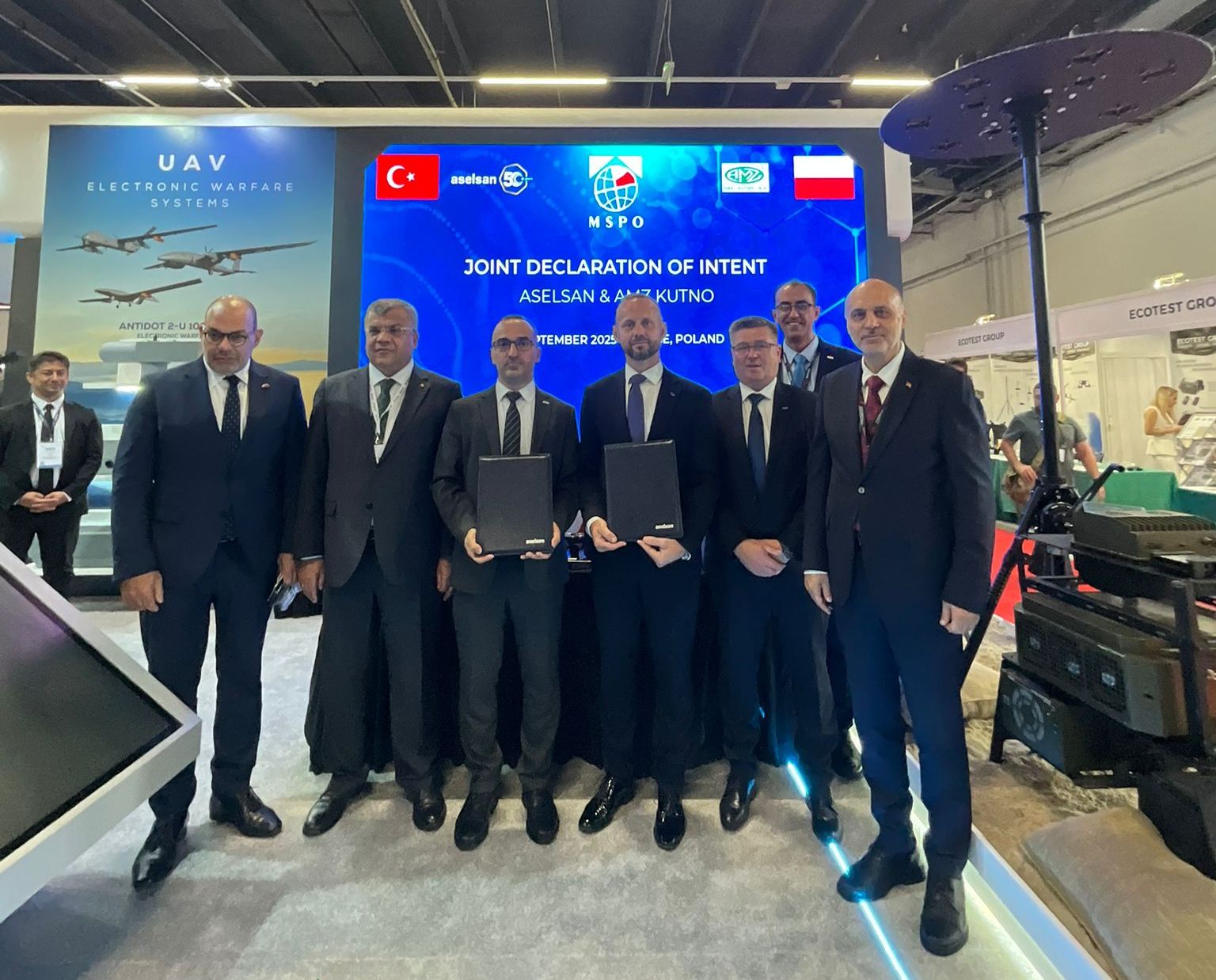
On Tuesday, 2 September 2025, the first day of the 33rd International Defence Industry Exhibition MSPO in Kielce, AMZ-Kutno announced that it had signed an agreement to expand its cooperation with the Turkish company Aselsan under the Light Armored Reconnaissance Carrier (LOTR) Kleszcz program for the Polish Armed Forces.
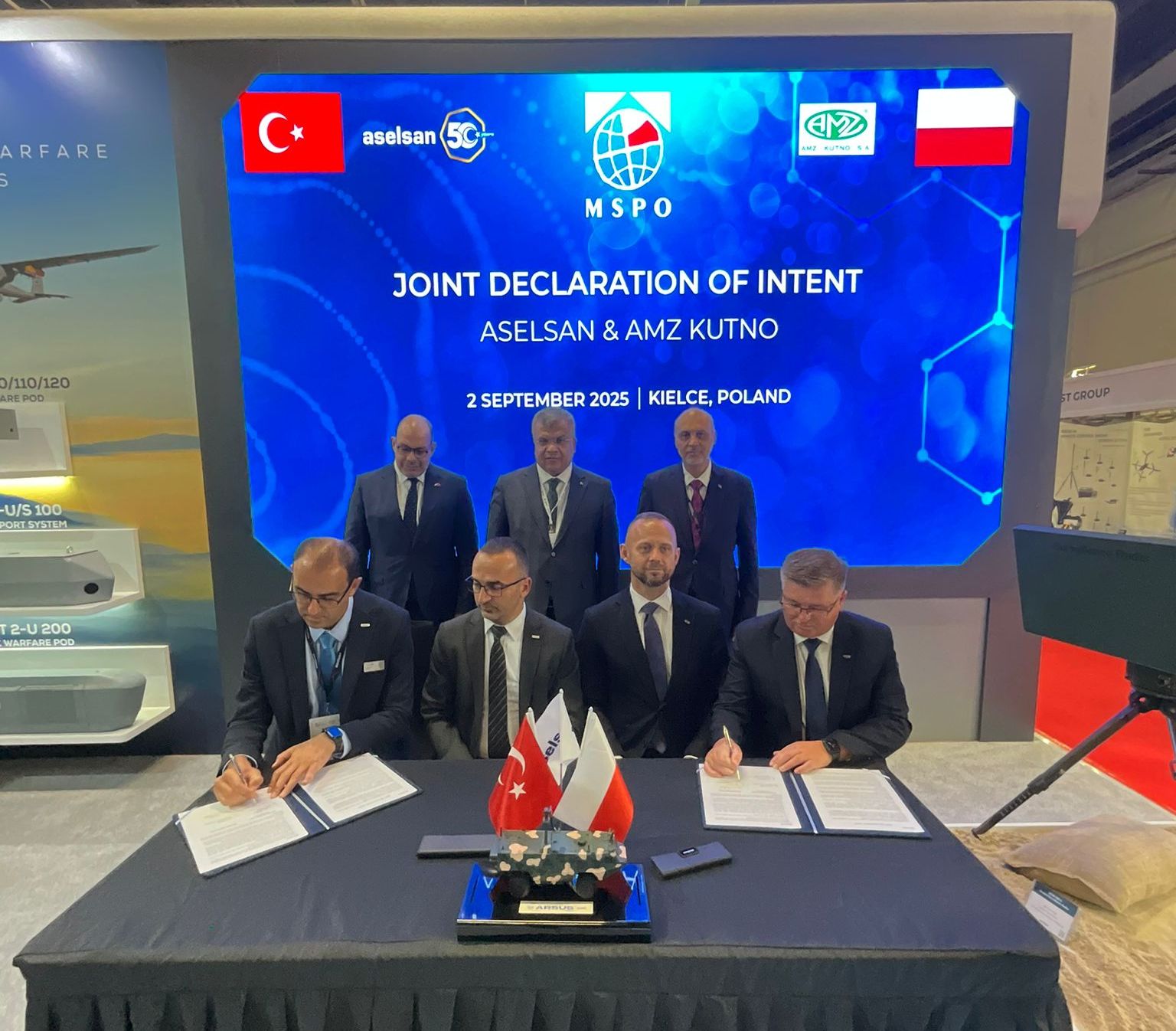 Photo: Paweł Ścibiorek, MILMAG
“Aselsan and AMZ-Kutno confirm their strong partnership and mutual intention to expand cooperation on LOTR vehicles for the Polish Armed Forces, paving the way for future successes,” the company Aselsan stated.
On 15 November 2024 Aselsan announced that it had signed a 16.632 million EUR contract (68.29 million PLN at the time) with AMZ-Kutno for the delivery of radar and electro-optical systems for the LOTR Kleszcz.
Details of the contract were not disclosed, but it likely covered 286 sets for all vehicles planned for procurement under the LOTR Kleszcz framework agreement of 28 February 2024, with deliveries scheduled through 2035. The first implementation contract, signed on 14 August 2024 and worth approx. 800 million PLN, includes the delivery of the first batch of 28 vehicles, with deliveries beginning in 2026. Given the scale of demand, technology transfer of Turkish solutions to Poland cannot be ruled out.
According to Ministry of National Defence requirements, the LOTR Kleszcz will be equipped with reconnaissance systems, including a tactical battlefield surveillance radar and an electro-optical sensor head. This will enable dynamic and continuous acquisition and collection of information about the adversary and the operational environment, along with processing and relaying this data as reconnaissance intelligence to higher command levels.
The Turkish company offers the ATEŞ Mobile Border Security System (Mobil Sınır Güvenlik Sisteminin), developed for domestic security services under a 2019 contract with the Turkish Ministry of the Interior (the first phase included 37 vehicle-mounted sets, with an option to increase to 57 in the second phase – a total worth roughly 30 million EUR). The system consists of a radar, a thermal imaging camera and electro-optical sensors enabling integrated short-, medium- and long-range surveillance, day and night, in all weather conditions. It monitors and records detected objects, marking their positions with geographic coordinates on digital terrain maps. The sets were deployed along the borders with Greece and Bulgaria.
The LOTR Kleszcz was developed under a 2013 agreement between the National Centre for Research and Development (NCBiR) and a consortium of Polish entities, consisting of: AMZ-Kutno (leader), the Military Communication Institute, the Military Institute of Armament Technology (WITU), and the Military Institute of Chemistry and Radiometry (WIChiR).
The 4×4 wheeled platform vehicle will enter service with reconnaissance subunits of the Polish Land Forces, providing the crew with an adequate level of protection and enabling the execution of reconnaissance missions.
The LOTR Kleszcz was developed on the chassis of the Bóbr-3 vehicle, equipped with a 6-cylinder diesel engine with a displacement of 7200 cm³ and an output of 240 kW, integrated in a power-pack configuration compliant with EURO 3 emission norms, an automatic transmission, all-wheel drive, and independent suspension. The vehicle is 6.9 m long, 2.38 m high, and 2.5 m wide. Ground clearance is 400 mm, and its weight ranges from 12 to 14 tons (depending on armor configuration, with a maximum permissible weight of 15.6 tons). Its operational range is 600 km. The maximum speed on paved roads is 90 km/h, with a range of 600 km, while its swimming speed is 7 km/h. The vehicle is adapted for fording and crossing water obstacles, including rivers with currents up to 1.1 m/s.
 Photo: AMZ-Kutno
The baseline Bóbr-3 can provide ballistic protection at levels 2 and 3 in accordance with STANAG 4569, and mine protection at level 2A. Additional armor panels increase protection to level 3. The vehicle’s structure is modular. The LOTR Kleszcz allows for transporting a five-soldier reconnaissance team. It is equipped with side doors for each seat located along the vehicle’s walls, as well as three evacuation hatches, enabling fast and safe crew evacuation both during tactical operations and technical recovery. The vehicle allows for transporting the crew together with personal and reconnaissance equipment, and provides fire support using onboard weapons, enabling engagement of lightly armored vehicles, low-flying aerial targets, and enemy personnel.
The key components of the Light Armored Reconnaissance Carrier include, among others, the following systems: reconnaissance system – equipped with a tactical battlefield surveillance radar and an electro-optical head; communications system – providing simultaneous communication between LOTR vehicles, helicopters, and command elements up to battalion level; armament system (remotely controlled weapon station) – fitted with 12.7 mm WKM-B and 7.62 mm UKM machine guns; filtration-ventilation and air-conditioning systems, as well as CBRN detection and protection; a laser warning system integrated with a smoke-grenade launcher.
The vehicle was designed in two variants: a light (amphibious) version with a lower protection level, and a heavy (non-amphibious) version with higher protection.
On 25 March this year, the Military Communications Institute – National Research Institute announced the launch of a competitive dialogue procedure for the delivery of Harris radio accessories for the LOTR Kleszcz information and communications system. Meanwhile, the Armament Agency is also interested in a Light Armored Reconnaissance Carrier (TRSk) codenamed EOS, which is to be based on the same platform.
25 marca br. Wojskowy Instytut Łączności – Państwowy Instytut Badawczy opublikował informację z uruchomienia postępowania przetargowego (dialogu konkurencyjnego) na dostawę osprzętu do radiostacji firmy Harris na potrzeby systemu teleinformatycznego i łączności do LOTR Kleszcz. Z kolei Agencja Uzbrojenie jest też zainteresowana lekkim opancerzonym transporterze rozpoznawczym (TRSk) o kryptonimie EOS, który ma bazować na tej platformie.
