


























Warsaw-based company AP-Flyer showcased several unmanned and counter-UAS solutions under the common name MADDOS (Multi-sensor Automatic Drone Detection & Observation System).
MADDOS VTOL 350e
The exhibition featured a fully electric vertical take-off and landing (VTOL) unmanned aerial vehicle, the VTOL 350e. It is the smallest UAV in the MADDOS family offered by the company. The aircraft has a wingspan of 3.5 meters and a maximum take-off weight of 22.5 kg, of which 2 kg is allocated for payload.
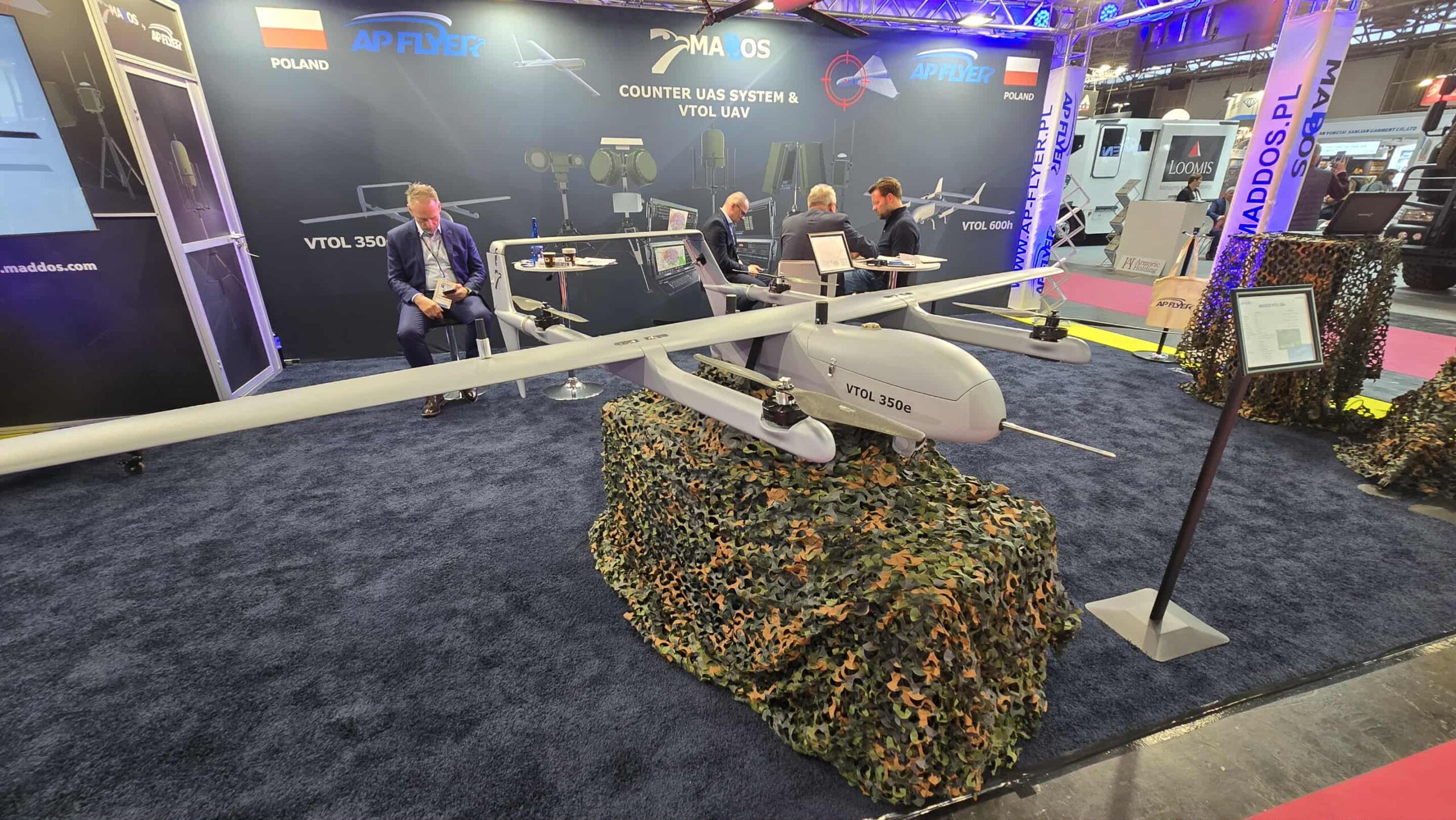 MADDOS VTOL 350e / Photo: Jakub Link-Lenczowski, MILMAG
The aircraft can operate for 3 hours, at altitudes up to 3000 m, with a maximum speed of 21 m/s, and in wind conditions up to Level 6. The radio link—supported by satellite navigation—provides a control range of 40 km. It carries an optoelectronic payload featuring a 40× optical zoom HD day camera and an 8× digital zoom HD thermal imager. The gimbal can detect and track targets, classify them using AI algorithms, geolocate, and record video. The UAV features a low acoustic and visual signature, can be prepared for flight in under 15 minutes, and is designed to operate in electromagnetically contested environments. AP-Flyer’s portfolio also includes the larger VTOL 450h and VTOL 600h hybrid-powered models (offering up to 25 kg payload capacity), though these were not shown at the exhibition.
MADDOS Assassin
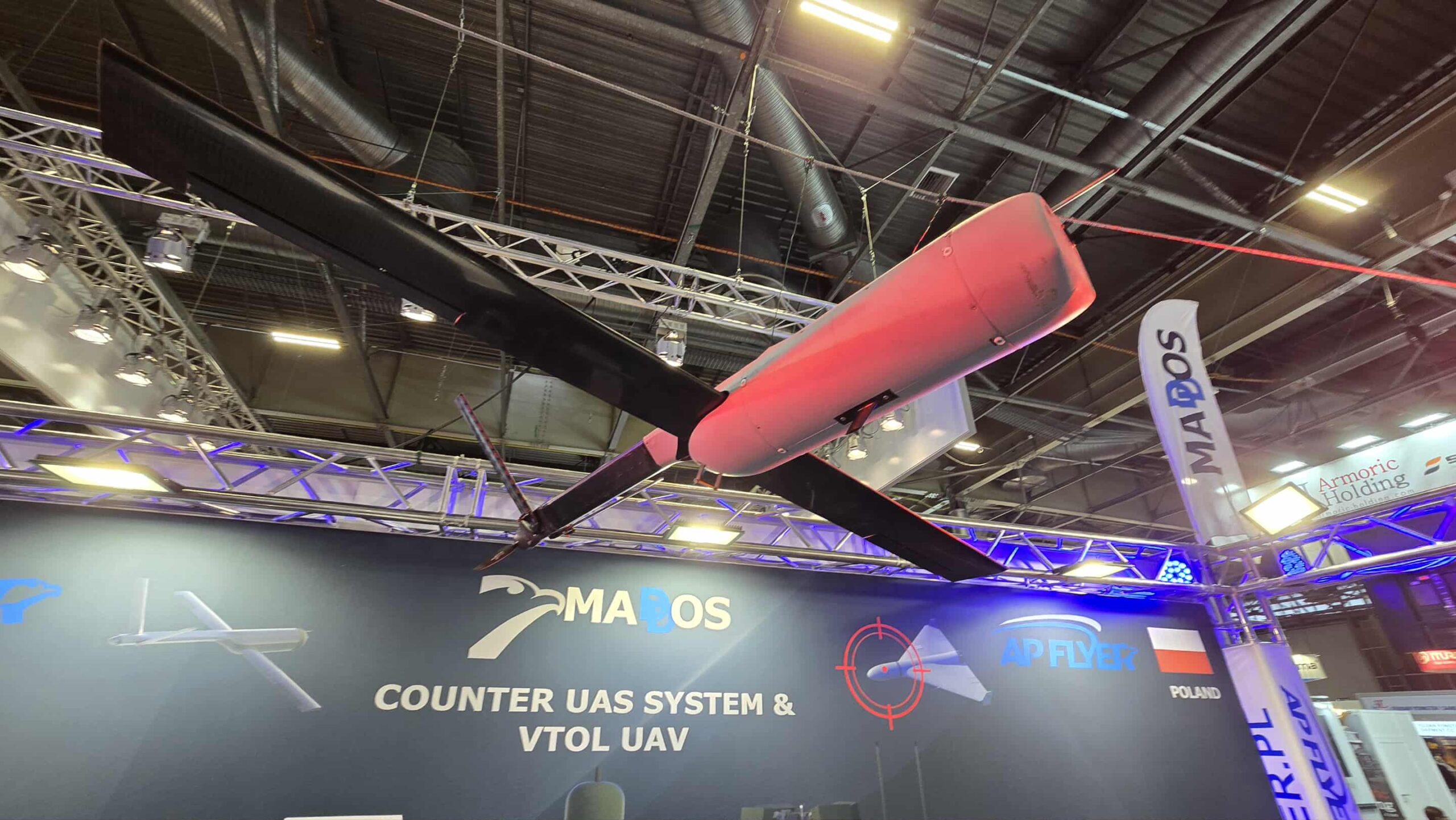
The company also showcased the MADDOS Assassin interceptor drone, featuring a takeoff weight of under 5.5 kg and a maximum speed of over 200 km/h. The system is guided by an advanced ground-based 4D AESA radar and equipped with an optoelectronic sensor used to track and intercept unmanned aerial vehicles through kinetic engagement in the terminal phase of flight.
 MADDOS Assassin
It is designed to destroy small Class 1 and Class 2 combat and reconnaissance unmanned aerial vehicles, as well as loitering munitions, at distances of up to 8 km from the launch point. The system is fully autonomous after launch and can be used both day and night, including in swarm-engagement scenarios.
MADDOS HandHeld-9
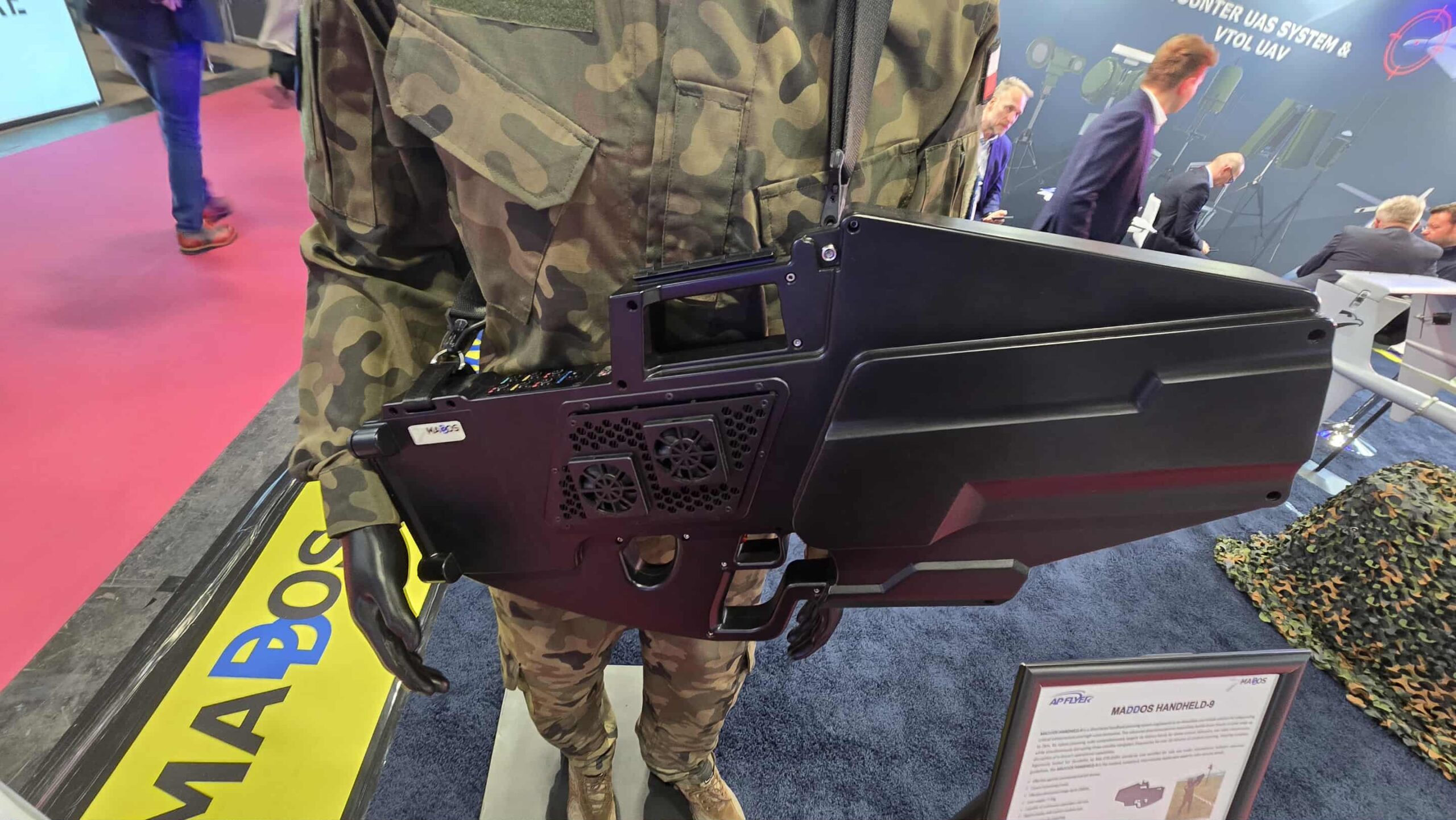
Another solution showcased was the MADDOS HandHeld-9, a non-kinetic counter-UAS system. This handheld anti-drone device is capable of neutralizing small unmanned aerial vehicles, primarily commercial platforms such as DJI drones, at distances of up to 2 km from the operator on the ground.
 MADDOS HandHeld-9
The 7.5-kg system is designed to protect critical infrastructure and personnel from the threat posed by small drones. It can jam the link between a hostile operator and their UAV across nine different frequencies (six RF bands and three GNSS bands) used for control, telemetry and video transmission, operating continuously for more than 60 minutes. It features a digital display with a built-in test module, a digital aiming compass, as well as radiation-safety certifications, IP65 (IEC 60529) environmental protection, and military-grade compliance with MIL-STD-461G and MIL-STD-810H.
MADDOS C-UAS
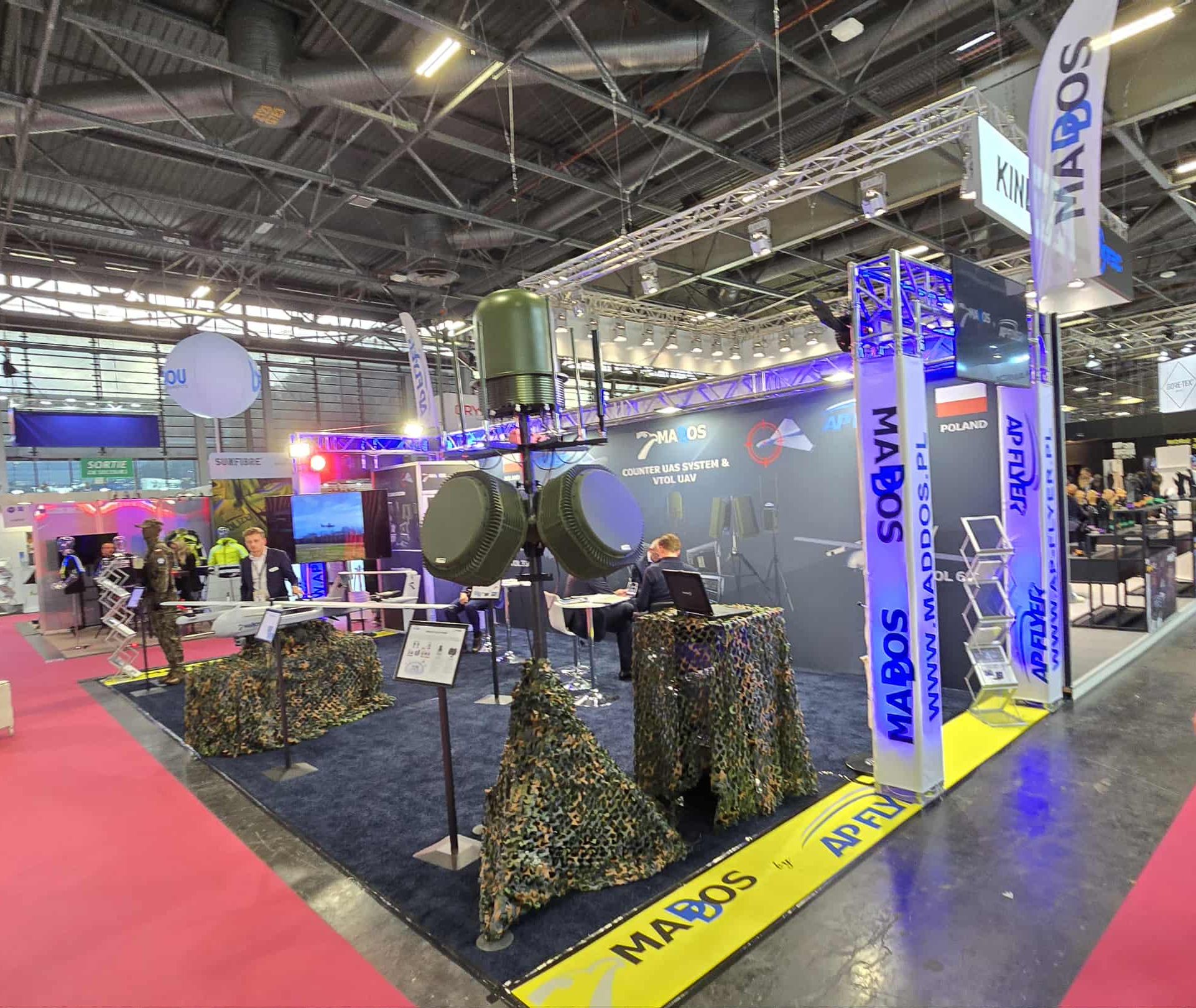
The final system showcased was the MADDOS C-UAS counter-drone suite. It is a complete, multi-sensor solution designed for effective detection and non-kinetic neutralization of unmanned aerial vehicles. The system integrates an AI-enabled command-and-control (C2) platform. It can be deployed in both static and portable tripod-mounted configurations and is intended to protect infrastructure facilities as well as military units on the move.
 MADDOS C-UAS system component (foreground)
The MADDOS C-UAS system consists of a passive radio-frequency (RF) jamming head based on Software Defined Radio (SDR) technology, capable of detecting targets at distances of over 15 km. Jamming is carried out across frequencies from 300 to 6000 MHz. The system can geolocate both hostile drones and their operators, and—thanks to a data library covering more than 600 known UAV types—provides precise identification of detected platforms.
Detection is ensured by the aforementioned 4D Doppler radar with an Active Electronically Scanned Array (AESA) operating in the S-band. It can detect a DJI-class drone at a range of 5 km and a larger platform such as the Shahed-136 at up to 15 km. The system also includes an electro-optical sensor head.
Non-kinetic neutralization is provided by spoofing modules and jammers, while kinetic interception is ensured by the MADDOS Assasin interceptor drone as well as a remote-controlled weapon station (RCWS).
