



























On Thursday, 27 November 2025, at the multifunctional Officine Farneto conference center in Rome, the Italian company Leonardo unveiled a concept for an integrated multi-domain defense system called Michelangelo Dome.
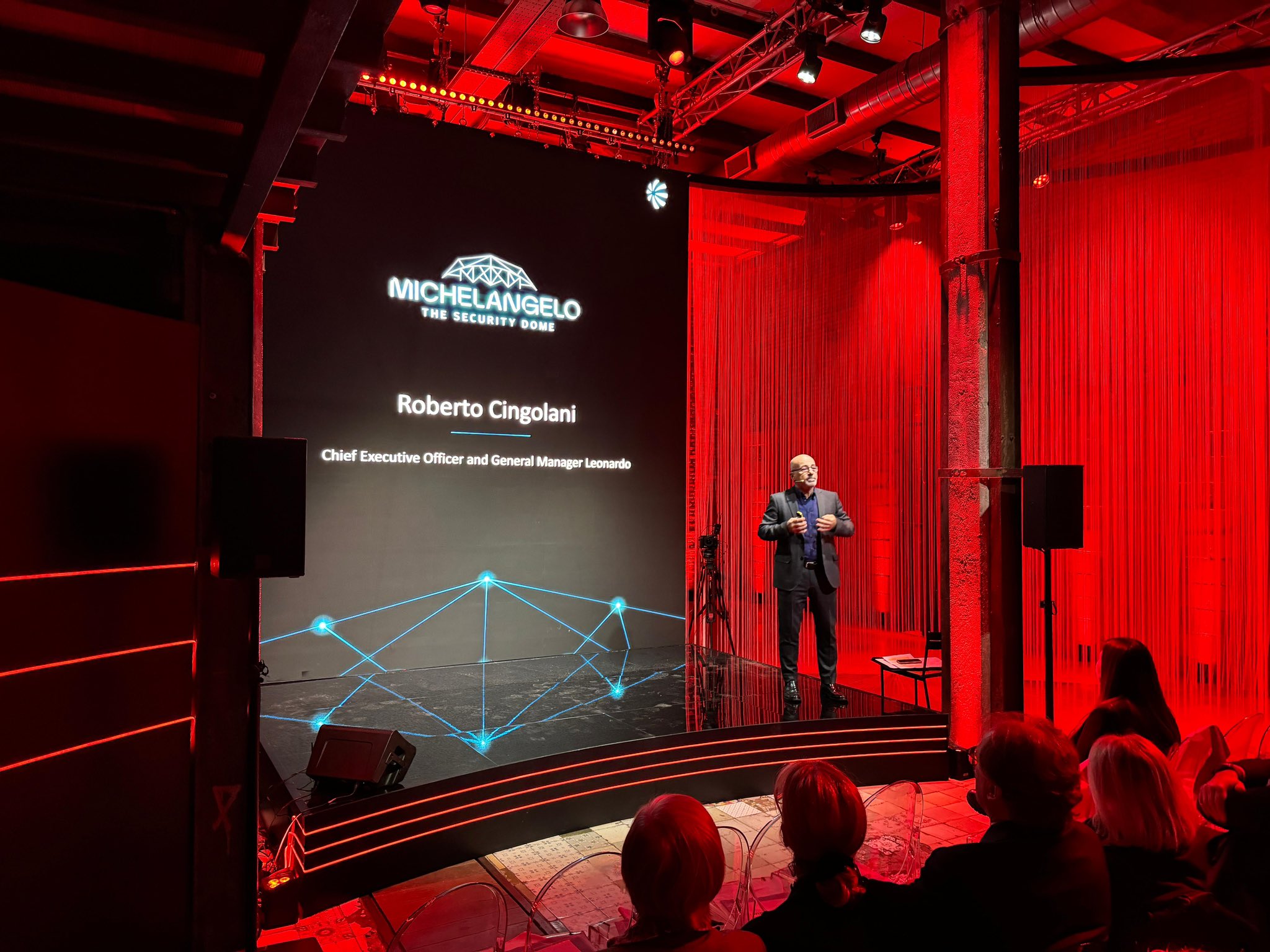
 The new, advanced defense system was presented by Roberto Cingolani, President and CEO of Leonardo / Photos and graphics: Leonardo
The project, developed to protect critical infrastructure, sensitive urban areas, and territories and assets of national and European importance through a modular, open, scalable, and multi-domain solution, fits into Leonardo’s broader strategy to strengthen its position as a leader in global security.
“With Michelangelo,” said Roberto Cingolani, Leonardo’s Chief Executive Officer and General Manager, “Leonardo reaffirms its commitment to developing solutions that safeguard citizens, institutions, and infrastructure by combining advanced technology, a systemic vision, and strong industrial capabilities. In a world where threats evolve rapidly and become ever more complex – and where defending is costlier than attacking – defence must innovate, anticipate, and embrace international cooperation.”
Michelangelo Dome will not be a standalone system, but rather a comprehensive architecture connecting next-generation sensors on land, at sea, in the air, and in space; cyber-defense platforms; command-and-control systems; artificial intelligence; and coordinated effectors. The platform will create a dynamic security dome capable of detecting, tracking, and neutralizing threats even during large-scale coordinated attacks across all operational domains: air and missile threats – including hypersonic weapons and drone swarms – attacks against land and surface targets from maritime approaches, as well as hostile ground forces.
Thanks to advanced multi-sensor data fusion and the use of predictive algorithms, Michelangelo Dome will be able to anticipate hostile actions, optimize defensive responses, and automatically coordinate the deployment of the most effective countermeasures.
With Michelangelo Dome, Leonardo strengthens its role as a European leader in multi-domain security and contributes to achieving strategic autonomy, technological resilience, and greater integration of Europe’s and NATO’s defense capabilities. This initiative aligns with broader continental cooperation programs and aims to further enhance the competitiveness of Italian industry.
As Roberto Cingolani emphasized during the presentation, traditional doctrines fundamentally separated land, air, and naval structures, which did not communicate with each other, and each was limited to its own mission. The goal of Michelangelo Dome is to create the missing connective layer that these doctrines lacked.
According to the presentation, Michelangelo Dome is intended to be a system of systems with distributed command-and-control capabilities, similar to the U.S. Integrated Battle Command System (IBCS), but encompassing all operational domains.
As reported by the Italian defense portal Rivista Italiana Difesa, the system is meant to facilitate decision-making in near real time by providing unified, coherent, and actionable information, and to enable multi-domain orchestration in assessing threats and selecting the appropriate countermeasures – ultimately ensuring that each threat is matched with the most suitable effector.

In other words, this will be a higher-tier command-and-control system that integrates with NATO’s existing capabilities and systems of this class, while also remaining compatible, with older and currently fielded platforms in several European countries (including those on NATO’s eastern flank), within the broader kill chain.
In this context, Cingolani emphasized that if an Eastern European nation cannot afford to purchase F-35s or the Patriot system but does possess an air-defense missile system, Leonardo can integrate it into Michelangelo Dome by adding the ability to communicate in accordance with NATO protocols and doctrines.
The system will be capable of performing computational analyses on data streams from radars, satellites, and infrared sensors amounting to hundreds of terabytes per second, while simultaneously ensuring cyber protection of this data. The core of Michelangelo Dome will be the MC5 integration module, deployed across various platforms and designed for ultra-low-latency data distribution and synchronization, along with AI-enhanced decision-support capabilities to accelerate the decision-making process.
All major Italian defense companies will take part in the Michelangelo Dome project. The system architecture was presented last month to Italy’s Minister of Defence Guido Crosetto, the Chief of the Defence Staff Gen. Luciano Portolano, and the chiefs of staff of all service branches. Cingolani highlighted that the first components of the Michelangelo Dome architecture will be developed by the end of 2027.
