





















On Friday, December 5, 2025, the U.S. Defense Security Cooperation Agency (DSCA) published the U.S. Department of State’s approval of a potential sale to the Kingdom of Denmark of the Enduring Shield (IFPC) air-defense system together with the Integrated Battle Command System (IBCS), in a package valued at up to 3 billion USD.
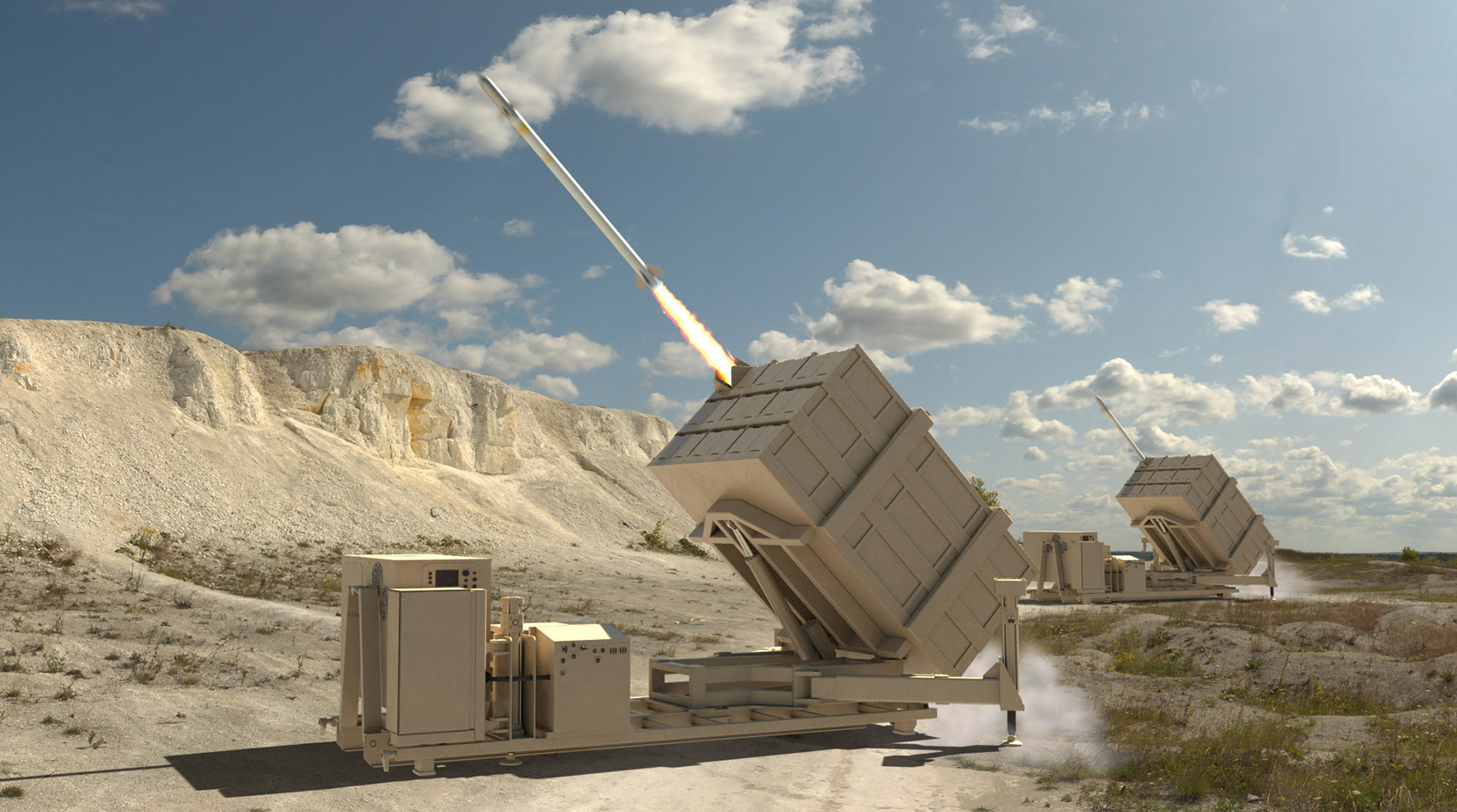 Image: Dynetics Inc.
According to the published information, the government in Copenhagen requested authorization to acquire 24 launcher canister modules to complete eight launchers, two AN/MPQ-64 Sentinel A4 radar stations with an AESA active electronically scanned antenna, and components of the IBCS system: two Engagement Operations Centers (EOCs), two ICE sets for operating in a virtual environment, and six radio relays as part of the Integrated Fire Control Network (IFCN).
In addition, the package includes the following non-MDE (Major Defense Equipment) items: transport and loading vehicles; communications equipment, including AN/PSN-13A DAGR satellite navigation receivers, AN/PYQ-10A cryptographic modules, AN/VRC-92F radio sets, RT-1523F transceivers, AN/TPX-61 interrogator sets, AN/TPX-57A(V)1 Identification Friend or Foe (IFF) devices; Type 1 Inline KG-250X NSA-certified network encryptors and KIV-77 encryptors; tools and test equipment; auxiliary equipment; generators; publications and technical documentation; training equipment, including a reconfigurable air-defense trainer; spare and repair parts; personnel training; on-site technical assistance team support; U.S. government and contractor technical, engineering, and logistics support (RTX, Lockheed Martin, Leidos, and Northrop Grumman); system integration and verification; field office support; and other related logistics and program support elements.
Analysis
Although, as stated in the DSCA announcement, Denmark has received approval to purchase the IFPC system, it had previously been rejected by the country’s Ministry of Defence during a tender process. Therefore, the publication of the approval appears to be only a formality, and the timing, or rather, the delay, may stem from the fact that between 1 October and 12 November this year a government shutdown was in effect, as the fiscal year 2026 budget had not been adopted on time. As a result, the DSCA is currently clearing its backlog.
For the record, it should be recalled that this system had been offered under the medium-/intermediate-range ground-based air-defense program (Jordbaseret Kortrækkende Luftforsvarssystem). Ultimately, however, the government in Copenhagen decided to procure all of the remaining competing systems — namely the Norwegian NASAMS (both the interim solution and the permanent one), the French VL MICA, and the German IRIS-T SLM.
It is also worth noting that the IBCS command system was offered by the United States together with the MIM-104 Patriot system in the long-range ground-based air-defense program (Jordbaseret Langtrækkende Luftforsvarssystem), in which the French-Italian Eurosam consortium was ultimately selected with its new-generation SAMP/T NG air- and missile-defense system (a product of the MBDA and Thales consortium).
Enduring Shield for US Army
Currently, under the Indirect Fire Protection Capability Increment 2-Intercept (IFPC Inc 2-I) phase, the Enduring Shield air-defense launcher is being developed, based on the previously tested Multi-Mission Launcher (MML) used by the U.S. Army. It has initially been integrated with AIM-9X Sidewinder surface-to-air missiles, and it is planned to use a new interceptor designated SHIELD (Short & Intermediate Effectors for Layered Defense) at a later stage.
The primary sensor is to be the standard AN/MPQ-64 Sentinel A3/A4 radar, and plans call for the procurement of up to 400 launchers.
Integration and testing of the Sidewinder with an early prototype of the Enduring Shield launcher were reported on 19 December 2023. The final fire unit is expected to comprise 18 missiles. Earlier, the aforementioned MML launcher had been used to test AGM-114L Longbow Hellfire anti-tank guided missiles against MQM-170 Outlaw drones simulating aerial targets. Miniature kinetic interceptors, the Lockheed Martin MHTK (Miniature Hit-to-Kill), were also tested from it. The launcher was additionally intended to be capable of firing Tamir and Stinger missiles.
On 9 December 2024, Northrop Grumman announced that the IBCS system had cooperated for the first time with an air-defense system under the IFPC program. On 30 July 2025, the U.S. Department of Defense awarded a 264.6 million USD contract to Dynetics Inc. (part of the Leidos group) for research, development, testing, and evaluation under the program.
