

































On Wednesday, 19 November 2025, during a press conference, UK Defence Secretary John Healey announced that the crew of the Russian oceanographic vessel RFS Yantar, Project 22010 Kriujs, operating near Scotland’s territorial waters, blinded the crew of a British Boeing P-8A Poseidon maritime patrol and anti-submarine warfare aircraft (locally designated Poseidon MRA Mk1) with a laser while the aircraft was monitoring the ship’s activity.
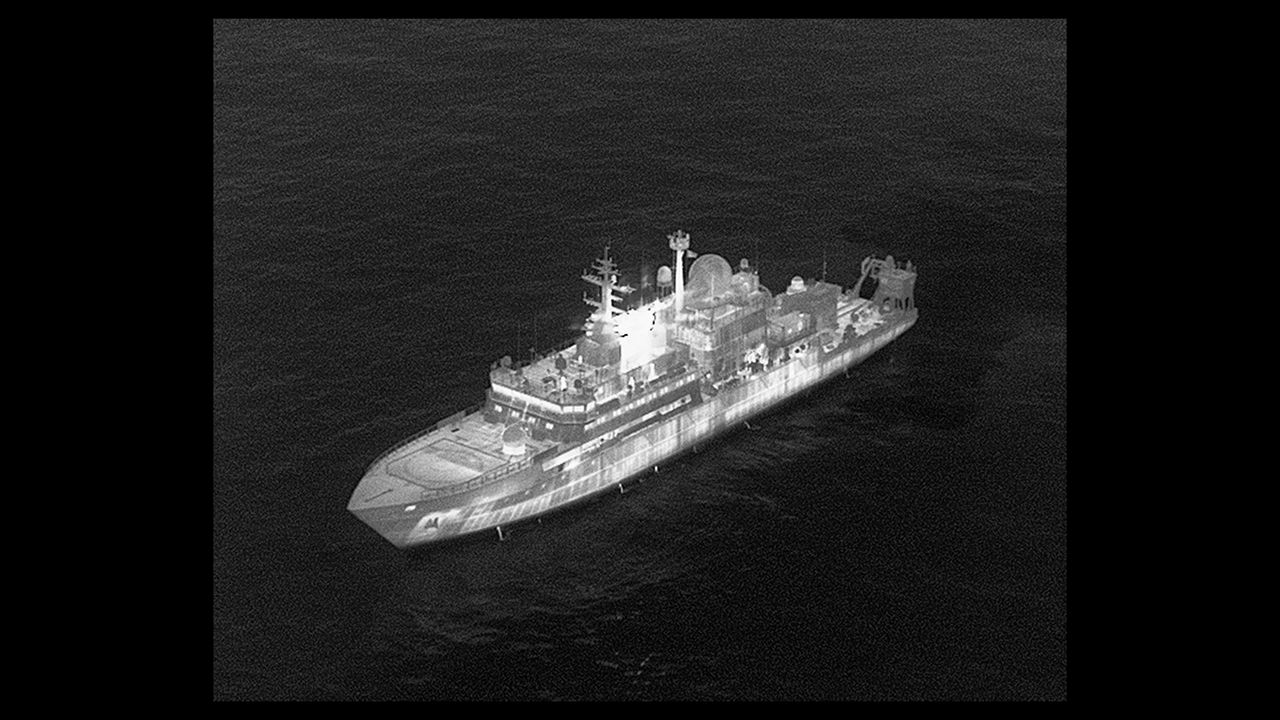 Photo: UK Ministry Of Defence
“The Defence Secretary John Healey this morning confirmed that a Russian spy ship – the Yantar – is on the edge of UK waters, north of Scotland, having entered the UK’s wider waters over the last few weeks.
This is a vessel used for gathering intelligence and mapping undersea cables, dragging sensors behind it. The RoyalNavy deployed frigate HMS Somerset, and the RoyalAirForce deployed P-8 aircraft to track the vessel’s every move, during which the Yantar directed light lasers at our pilots.
This is the second time this year that this Russian spy ship has deployed to UK waters. It is one of many Russian vessels designed to threaten our Critical Underwater Infrastructure.
To Russia: We see you. We know what you are doing. And if Yantar travels South this week, our Forces are ready to act.”
During a press conference at the Prime Minister’s residence on Downing Street, Defence Secretary John Healey stated that RFS Yantar supports Russia’s so-called Shadow Fleet, whose vessels, aside from transporting sanctioned crude oil and refined products, have repeatedly carried out suspicious maneuvers near locations where NATO and EU undersea cables run through European waters. The Shadow Fleet is estimated to consist of at least 600 vessels.
The incident in which the crew of a Poseidon MRA Mk1 was blinded was described by the British defence chief as ‘deeply dangerous’ and a dramatic escalation. He added that Yantar’s activities in European waters are not part of an ordinary voyage:
“This is not just a maritime operation. It is part of a Russian programme run by what they call the Main Directorate of Deep-Sea Research of the Navy, or GUGI for short, and it is intended to provide the capability for peacetime surveillance and sabotage during conflict,” he explained.
“That is why we have been determined that whenever Yantar enters the wider UK area, we track it, we deter it, and we tell Putin that we are ready – and we do this together with our allies. You saw this last year in the way the UK led the response to the attacks on critical infrastructure alongside other Baltic and Nordic countries, and then NATO also stepped into their operation. So this is a demonstration, if you will, of Britain’s readiness to act, Britain’s deterrent capability, because make no mistake, we will not tolerate threats to the fundamental interests of the British nation under the sea,” Healey added.
To recall, on the night of 15–16 January this year, a French Dassault Atlantique 2 (ATL2) maritime patrol aircraft was tracked and then illuminated as if for targeting by the crew of a Russian S-400 Triumf air and missile defense battery (DIA/NATO codename: SA-21 Growler) during a flight over the Baltic Sea.
As for Yantar, according to AIS data, the ship had been sailing in the Baltic Sea since January, where it was seen near Skagen, Denmark, similarly to 2024. After transiting the Danish straits toward the North Sea and then the English Channel, it was shadowed by the Royal Navy frigate HMS Somerset and the patrol vessel HMS Tyne.
Earlier, in November last year, it moved through the English Channel accompanied by the Russian frigate RFS Admiral Golovko (Project 22350 Admiral Gorshkov-class) and the tanker Vyazma. It then headed into the Irish Sea, loitering near Cork, between Dublin and the Isle of Man, precisely in areas dense with undersea telecommunications cables. On 9 November, it briefly switched on its AIS transponder, interpreted as a deliberate signal of presence. It was eventually escorted out of the Irish Sea by the Irish patrol vessel LÉ James Joyce at the end of November.
In 2023, the vessel was observed in the Baltic Sea, including near Danish and Swedish territorial waters, where it operated close to Swedish energy and telecom cables. It took part in Russian Baltic Fleet exercises simulating underwater operations and infrastructure defense. In September it moved to the Fram Strait in the north, where it shadowed the Norwegian research vessel RV Kronprins Haakon for 16.5 hours, which was being escorted by the Norwegian Coast Guard ship Barentshav (W340). After returning to the Baltic, it operated near Finland and Estonia, close to damaged cables (including after the attack on the Balticconnector gas pipeline). In November–December it was again noted in the North Sea and the English Channel.
After Russia’s full-scale invasion of Ukraine, in March 2022 it was observed near Norway’s Svalbard archipelago, then moved to the North Sea and the Baltic, where it appeared after the Nord Stream 1 & 2 explosions in September.
In previous years, the vessel was also active. In August 2021, Yantar carried out suspicious maneuvers near Ireland, where the AEConnect-1 undersea cable is located. Its crew had earlier been accused of similar activities, for example in the Caribbean in 2015, near the transatlantic communications fiber linking Europe and North America, as well as near US Navy undersea cables. In November 2019, the ship appeared off Trinidad and Tobago, and in February 2020 it likely surveilled cabling near Rio de Janeiro, belonging to the Brazilian Navy. There is suspicion that the vessel is equipped with underwater vehicles capable of cutting cables.
The Defence Secretary @JohnHealey_MP this morning confirmed that a Russian spy ship – the Yantar – is on the edge of UK waters, north of Scotland, having entered the UK’s wider waters over the last few weeks.
This is a vessel used for gathering intelligence and mapping… pic.twitter.com/GO6LXVAfgU
— Ministry of Defence 🇬🇧 (@DefenceHQ) November 19, 2025
