






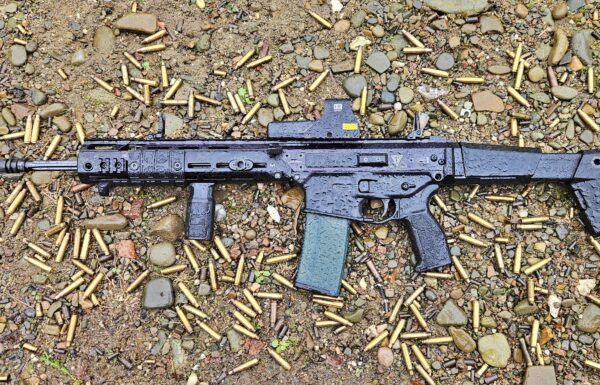








The Light Machine Gun is a selective-fire, belt-fed weapon with an optional emergency feeding capability using standard magazines. It is equipped with ambidextrous controls adapted to the needs of both right- and left-handed shooters. A steel MIL-STD-1913 (Picatinny) rail is mounted above the aluminum receiver cover, allowing the installation of electro-optical sights, night-vision and thermal imaging attachments, as well as backup iron sights. The receiver cover itself hinges to the side, enabling rapid ammunition replenishment. The weapon is fitted with quick-change barrels ranging from 11.5 to 20 inches in length. As standard, the designers selected a 14.5-inch barrel, matching the barrel length used on the MSBS Grot A3 carbine (Contract for MSBS Grot A3 assault rifles for the Polish Armed Forces).
 During MSPO 2026, WITU, Fabryka Broni and WAT presented the Light Machine Gun, a Polish counterpart to the FN Minimi or Evolys / Photo: Jakub Link-Lenczowski, MILMAG
The new weapon is expected to provide a cyclic rate of fire of 650–750 rounds per minute and to effectively engage point targets at ranges of up to 500 m, while area targets can be effectively engaged out to 800 m. Its design is based on firing from an open bolt. In this context, the ability to fire single shots is particularly important. As the designers emphasize, this is a feature of the latest machine guns that facilitates accurate fire at longer ranges. The quick-change barrel can be replaced in field conditions after heating up during intensive firing. Importantly, from the outset the weapon has been designed to allow the use of sound suppressors. This is to be enabled by adapting the muzzle device and the gas system settings, allowing the weapon to operate in a normal mode, when fouled, and with a suppressor fitted. However, according to Fabryka Broni, the final functionalities will be verified throughout all stages of testing.
 Muzzle device on the 14.5-inch quick-change barrel, with the gas regulator visible / Photo: Jakub Link-Lenczowski, MILMAG
The new weapon is designed to offer a high degree of modularity and adaptability to changing user requirements. Its low weight of 5.5 kg (6 kg with the bipod), together with a length of 996.5 mm with the stock extended, a height of 237 mm and a width of 83 mm in the 14.5-inch-barrel configuration, makes it convenient for use even by individual soldiers and also facilitates transport in the troop compartments of armored personnel carriers. The weapon is currently chambered for 5.56×45 mm ammunition, but can be readily adapted to .300 Blackout. A variant chambered for 7.62×51 mm ammunition is also planned. At present, the designers envisage belt feeding using M27 disintegrating links, as in other machine guns produced for NATO requirements. Ammunition bags with capacities of 100, 150 and 200 linked rounds are planned.
 The Light Machine Carbine is fed with ammunition using an M27 disintegrating-link belt / Photo: Jakub Link-Lenczowski, MILMAG
The weapon presented has not yet been adapted for feeding from box magazines. However, the designers confirm that, at the clear request of the contracting authority, the LKM can be adapted for such a function, as the weapon’s design allows for it. It should be remembered, however, that the demonstrator presented at MSPO is in an initial configuration. It allows the weapon to be adapted to soldiers’ needs, similarly to the MSBS Grot rifles (MSBS Grot: A Polish firearm with its own DNA). The LKM has been fitted with M-LOK mounting slots and an adapter for a stock in the AR-15 standard. The weapon allows the mounting of electro-optical sights, flashlights, and laser aiming devices.
 Adapter kolby LKM / Zdjęcie: Jakub Link-Lenczowski, MILMAG
As MILMAG has learned, the weapon is still at an early stage of development. According to Fabryka Broni Łucznik-Radom, the design has reached Technology Readiness Level VI and is currently undergoing factory testing. Reaching the final, ninth level is expected to take up to two years, although the LKM will most likely be able to enter familiarization trials with the Polish Armed Forces as early as 2028. The weapon will most likely be offered with two quick-change barrels. The manufacturer states that barrel lengths of 11.5, 12.5, 14.5, 16, 18 or 20 inches will be available. Interestingly, the handles used for barrel replacement are to be removable in order to improve ergonomics during carrying and combat use.
