




















During the 34th International Defence Industry Exhibition (MSPO 2026) at Targi Kielce, Ukrainian company Fire Point presented mock-ups of the FP-5 Flamingo cruise missile and the FP-7 and FP-9 ballistic missiles in Poland for the first time.
FP-5 Flamingo
First publicly unveiled on August 17, 2025, the missile was designed by Milanion Group Ltd, a privately owned company registered in the United Kingdom, and is serially produced by Kyiv-based Ukrainian company Fire Point. The Armed Forces of Ukraine use the system, described by the manufacturer as a hybrid of a combat UAV and a cruise missile, to strike strategic targets in Russia’s rear areas.


Main photo: Paweł Ścibiorek; gallery photos: Hyunmin Park, MILMAG
Milanion Group Ltd first displayed a mock-up of the missile at the IDEX 2025 International Defence Exhibition and Conference in Abu Dhabi, United Arab Emirates, in February last year.
The missile features fixed wings and an engine mounted on top of the fuselage. It is 14 m long, has a wingspan of 7 m and a launch weight of 6,000 kg, including a 1,150 kg warhead. Its declared maximum range is 3,000 km, although this has not yet been confirmed in combat. So far, the longest distance covered during strikes against targets in Russia has exceeded 1,500 km.
Cruise propulsion is provided by an Ivchenko-Progress AI-25TL turbofan engine, enabling operation at altitudes from 20 m to 10,000 m, a maximum flight time of four hours, a cruising speed of 650–700 km/h and a maximum speed of 950 km/h. Preparation for launch from a ground platform, with the use of a solid-fuel rocket booster, takes 20 minutes. The guidance system combines a jam-resistant GPS/GNSS/GLONASS satellite navigation system with inertial/dead-reckoning navigation. Claimed accuracy is 14 m.
Ukraine had ambitious plans to increase production from an initial 30 to 210 missiles per month, with Danish assistance, including a facility in Vojens, Jutland, intended to produce solid propellant for the FPRT booster, announced on September 3 last year. However, on February 15 this year, Ukrainian President Volodymyr Zelensky acknowledged that the existing production line had been destroyed in a Russian strike. Current production capacity remains classified for obvious reasons.
Ukraine has used Flamingo missiles in combat in 12 strikes, during which fewer than 30 missiles were launched, although these estimates may be understated. The most recent known strike involving the system took place on August 15 in Samara, where the Aviakor and Progress enterprises were targeted.
FP-7 and FP-9
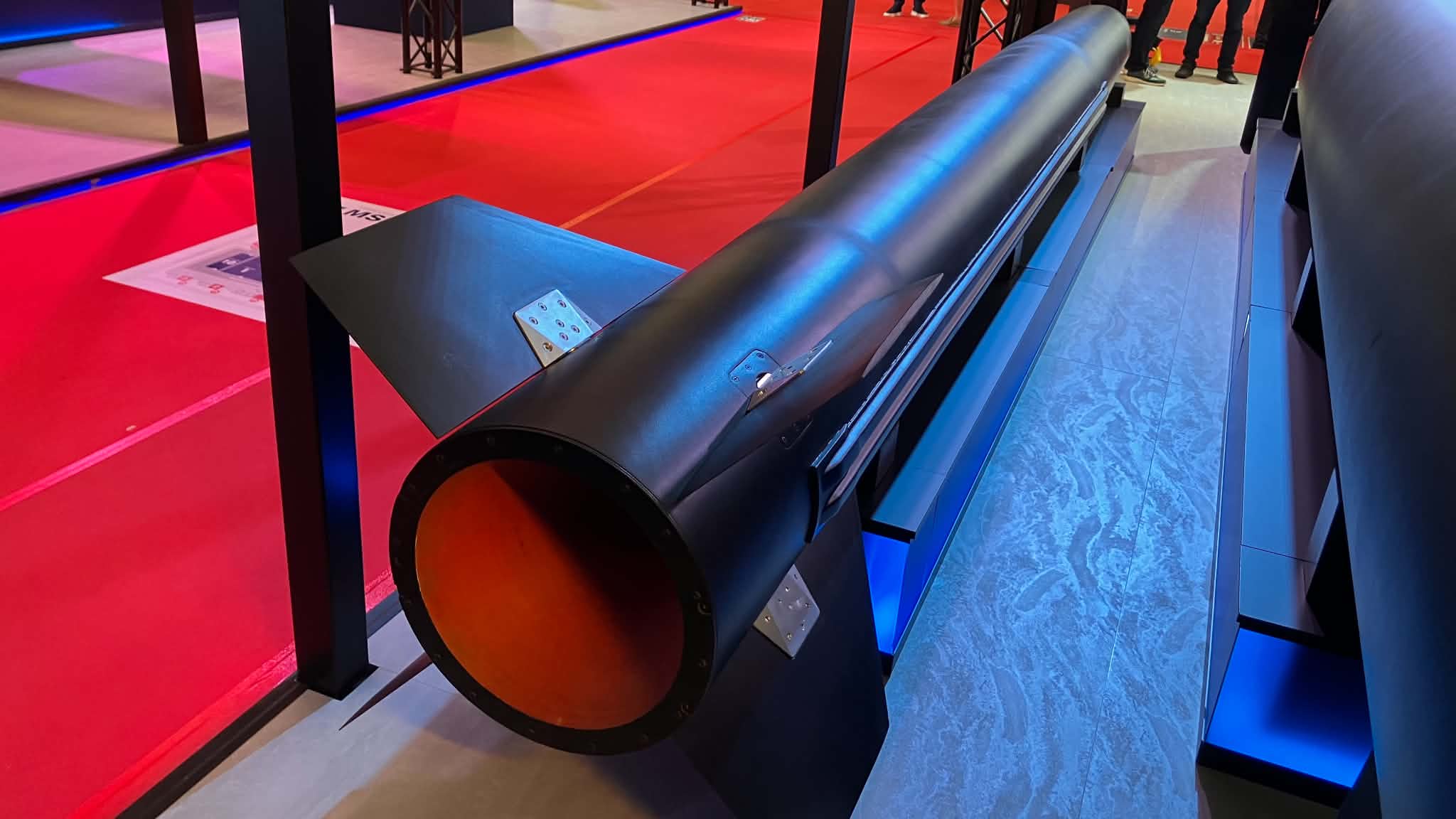
Fire Point also presented mock-ups of two ballistic missiles: the tactical FP-7 and the operational-level FP-9 (the smaller and larger missiles, respectively, in the photographs below).




Photos: Hyunmin Park, MILMAG
FP-7 is a tactical ballistic missile with an operational range of up to 200 km, although later statements put the figure at 300 km, a maximum speed of approximately 1,500 m/s, and a warhead weighing around 150 kg. The missile can remain in flight for up to 250 seconds and has an estimated accuracy of approximately 14 m CEP when launched from a ground platform.
First tested on February 28, 2026, it is based on the design of the Soviet 48N6 interceptor missile used by the S-400 Triumf air and missile defense system, although its design has been simplified. It uses a hot-launch method in which the solid-fuel motor ignites directly inside the launcher, with the missile travelling along an inclined launch rail rather than being launched vertically.
Although the design is derived from the Soviet era, the airframe is made of carbon fiber and fitted with modern electronics. The use of Ukrainian-produced solid propellant and the hot-launch method may enable faster combat employment and improved concealment.
The cost of the FP-7 is estimated at around half that of the U.S. MGM-140 ATACMS ballistic missile, while carrying a larger warhead. According to the manufacturer, the launchers can be concealed to resemble ordinary trucks.
The company is currently working on the FP-7.x interceptor missile as part of the pan-European Freyja missile defense system project under a 10-nation Anti-Ballistic Coalition, which Poland has expressed interest in joining.
FP-9 is an operational ballistic missile with a declared range of 855 km. It has not yet been officially completed. In June, a test of the FP-9’s main propulsion system was reportedly planned, to be followed by a combat test against a target on Russian territory. However, there are indications that the missile may have been involved in the unsuccessful ballistic attack on Moscow on June 30.
The missile is intended to be capable of striking the Russian capital from Ukrainian territory while carrying an 800 kg conventional warhead. It is expected to reach speeds of up to 2,000 m/s (Mach 7) at altitudes of up to 70 km. The main propulsion system is reportedly designed to operate for 520 seconds. The missile’s accuracy is stated to be 20 m.
The missile is intended to be launched from a ground platform, providing a high degree of strategic flexibility, mobility and adaptability to different operational scenarios and mission requirements.
FP-9 has been designed for operational-strategic missions, meeting modern requirements for range, reliability and effectiveness. The system architecture allows integration with existing command, control and reconnaissance systems and also provides scope for future upgrades.
