

















The Łukasiewicz Research Network’s presence at this year’s MSPO in Kielce focused on agreements concerning, among other areas, the production of special aluminum powders and primers for ammunition, the development of the Polish UNIPeX explosive and ammonium perchlorate used in rocket propellants, as well as the Air-Power system designed to supply power to aircraft and airport infrastructure in the event of a failure or blackout.
 Photos: PAP / P. Polak
“This is a very important day for us. The agreements with companies of the Polish Armaments Group are particularly significant (…), as is the agreement with Telesystem-Mesko, with which we are establishing a special-purpose company” – said Dr. Hubert Cichocki, President of the Łukasiewicz Research Network.
The new company will develop silicon technologies for the Piorun air defense system and future missile solutions. The project is intended to increase the share of domestic technologies in strategic weapon systems and reduce dependence on foreign suppliers.

The agreements concluded by Łukasiewicz are an example of putting into practice the conclusions of the debate on technological sovereignty held during MSPO in Kielce. Participants in the discussion emphasized that building national defence capabilities requires close cooperation between the military, academia, and industry.
Former Chief of the General Staff of the Polish Armed Forces Gen. Mieczysław Cieniuch pointed out that the role of the armed forces is to define operational requirements, while the response to those requirements should be developed jointly by the scientific and industrial communities.
“The military is looking for capabilities,” Gen. Cieniuch said. “Looking at the openness demonstrated, for example, by engineers from the Łukasiewicz Research Network, I think we have something to be proud of,” he added. As Gen. Cieniuch noted, the key is to ensure that the record levels of funding allocated to security translate into lasting national capabilities.
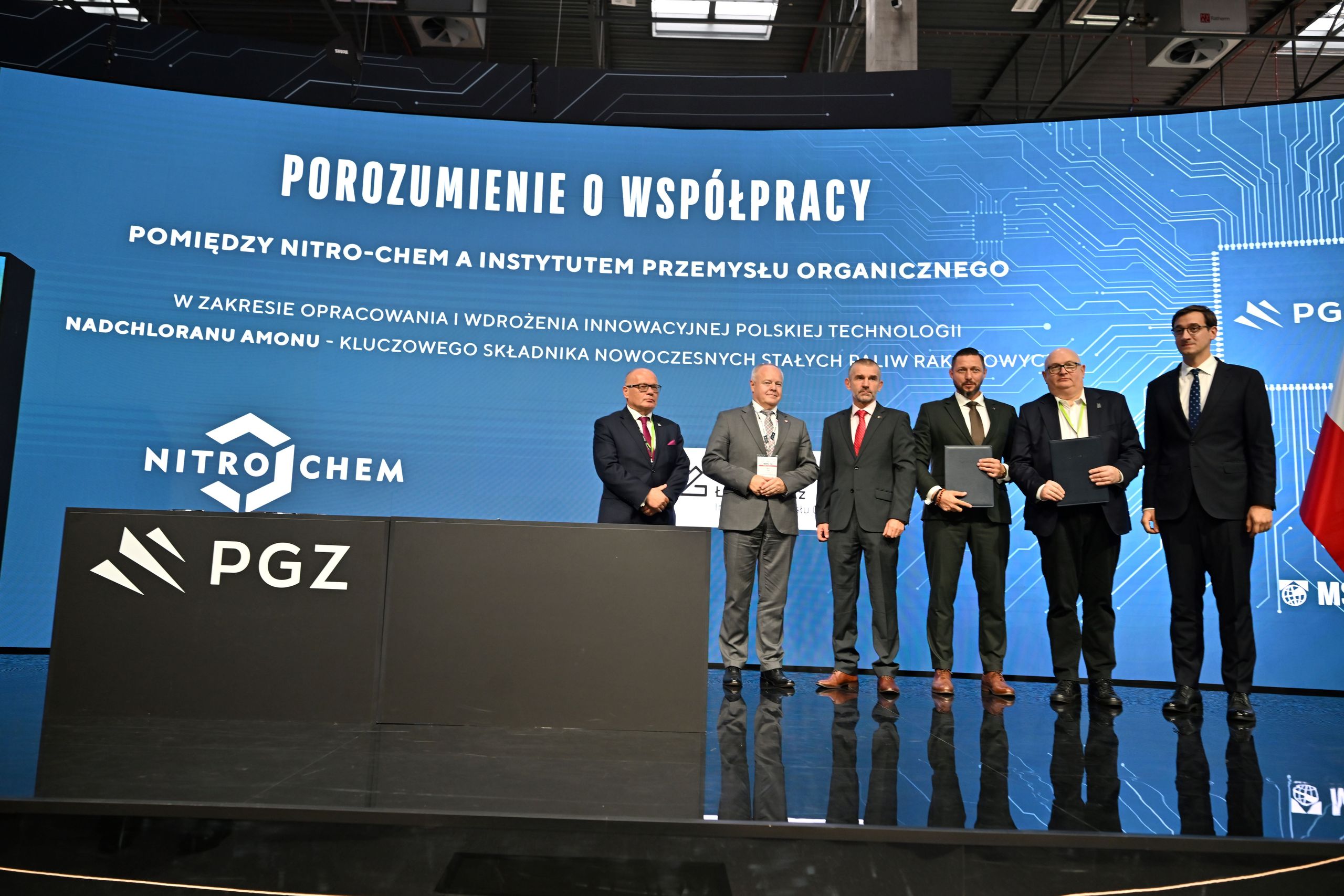
Representatives of the defense industry also emphasized the importance of cooperation with Łukasiewicz. Dr. Mateusz Roszkiewicz, Director of the Ammunition and Missile Technology Domain Department at the Polish Armaments Group, noted that the industry’s growing production requirements call for increasingly strong support from the research and development sector.
“Recently, with the emergence of much greater demand for defense products, cooperation with the scientific community, and particularly with Łukasiewicz, has intensified. Today, the defense industry faces so many challenges related to meeting production requirements that the scientific community serves as a bridge that can help industry develop the capability to offer new and improved solutions,” Roszkiewicz said.
As he stressed, this cooperation is also important from the perspective of supply chain security. “Our goal is to establish capabilities that will enable the domestic industry to secure them as effectively as possible. (…) It is also about ensuring the security and sovereignty of our supply chain. And for that, we need the scientific community,” the PGZ executive added.

According to the President of the Łukasiewicz Center, the agreements signed during MSPO demonstrate that joint efforts by research institutes and companies are producing tangible results.
“I believe this is an important task for the Polish defense industry. If we do not use public funds in a way that both provides security and strengthens domestic industry, we will instead be financing economic growth in the countries from which we import weapons and technology,” Dr. Hubert Cichocki said.
During the exhibition, Łukasiewicz also signed a strategic partnership agreement with Eycore, a company developing dual-use radar and satellite technologies for both civilian and military applications. The cooperation is expected to include, among other areas, the integration of SAR radar technologies with satellite platforms being developed in Poland.
“We are moving from intentions to implementation. The strategic partnerships we have been building with defense-sector companies over the past two years are delivering tangible results,” emphasized Dr. Hubert Cichocki, President of the Łukasiewicz Center. As he noted, the agreements signed during MSPO demonstrate that cooperation between science, business, and the military can translate into specific technologies that strengthen national security and domestic industrial sovereignty.
Video: PAP
Information Source: PAP MediaRoom
See also:
